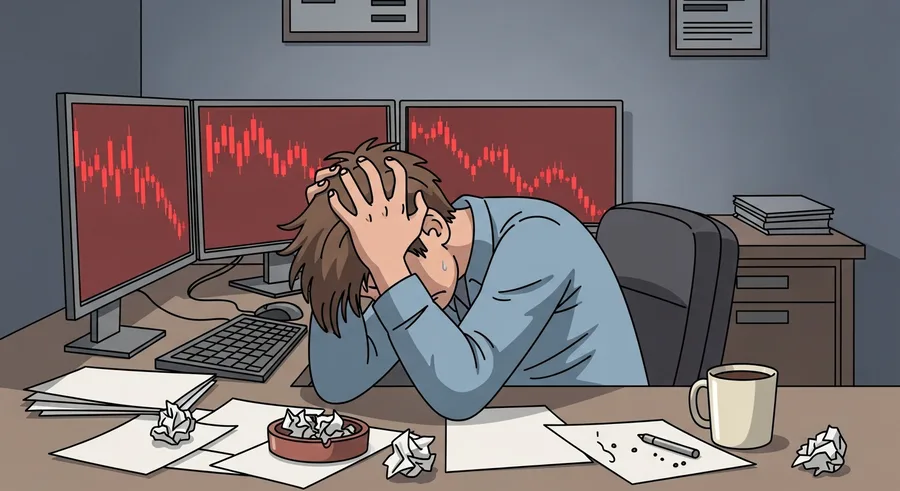

Challenge failures are usually not a verdict on whether a trader can identify a market idea. They are more often a mismatch between ordinary losing-trade variance and a position size that leaves no room to be wrong. A useful review begins with the account history, not with a search for a faster entry signal.
The aim is to find the first controllable break in the chain. Was risk increased after a win, was a stop moved, was a rule misunderstood, or did a trader continue after the personal daily limit? Naming one behavior makes a correction testable on the next attempt.
This guide explores how to methodically review your past evaluation attempts to identify systemic errors rather than blaming market conditions. By treating the trading process as a series of repeatable decisions, you can move away from emotional reactions and toward a stable execution framework. Every trader hits a wall during an evaluation, but the distinction between a permanent failure and a temporary setback lies in how you dissect your logs.
Most traders look at the final balance and assume they need a better strategy. In reality, they likely need better boundaries. This analysis breaks down the most common failure modes into actionable areas of focus. It provides a way to look at your trades as data points to be refined. You will learn to spot the patterns that turn a simple drawdown into a total account blowout.
If you are comparing independent preparation with structured support, the main prop firm passing service guide places why prop firm traders fail challenges and how to build a better process inside the complete evaluation process.
The Failure Pattern Behind the Failure
Most blown evaluations have a sequence, not a single cause. Mark the first departure from the plan, such as adding size after an early winner, rather than treating the final losing trade as the whole explanation. It is almost never the last trade that matters. The damage is usually done by the shift in mindset that preceded it by an hour or more.
Replay the day in order and note account equity before every order. That timeline shows whether the breach came from a valid setup, a recovery decision, or several small losses that exceeded the planned session budget. Seeing the sequence clearly often reveals that the final blowup was actually the inevitable result of a slide that began much earlier in the session.
Consider a hypothetical case where a trader loses 0.5% on a trade. This is within the plan. However, the trader feels irritated and decides to double the position size on the next trade to recover the loss quickly. This is a behavioral shift. Even if the setup is technically sound, the decision to increase size based on emotional frustration constitutes a failure in process discipline.
Identify patterns behind trade failure
When you look back at your history, identify the exact moment your actions deviated from your written guidelines. Was it an impulse to win back funds? Was it a desire to finish the day with a profit? Once you identify the specific moment that the plan was abandoned, you have a specific point to target for improvement in your next session.
Oversizing and the Loss of Flexibility
Oversizing turns an ordinary stop into a decision crisis. If one full loss consumes a large share of daily room, a second valid setup becomes emotionally and mathematically difficult to take. You lose the ability to participate in the market because you have effectively bet your remaining evaluation allowance on a single outcome. This creates a trap where one bad result ruins your ability to trade effectively.
Set risk from the stop distance and remaining loss buffer, not from the amount needed to reach the target. Include commission and likely slippage so the planned loss is not an optimistic estimate. If your daily loss limit is $1,000, treating every trade as if it could hit that entire limit is dangerous. You must divide that budget into smaller, manageable portions to allow for standard market noise.
Hypothetically, imagine you have a $500 daily loss limit. If you size a trade so that your stop loss requires $400, you are risking 80% of your daily budget on one position. If that trade hits your stop, your remaining buffer is only $100. You have essentially ended your own trading day because you cannot reasonably take another trade with such a tiny remaining margin.
Maintain flexible position sizing
Instead, size your position so that a single stop loss accounts for a fixed fraction of your daily limit. If you plan for 5% of your daily limit per trade, you can endure multiple losses while still having the capital and the confidence to take another setup later in the day. This keeps you in the game when you need to be there most.
Revenge Trading and Target Pressure
Revenge trading often begins as an attempt to restore a number, not to follow a setup. The danger is greatest immediately after a stopped trade or when the target feels close. You might see a small move and decide to enter, hoping for a quick win to fix the previous loss. This is a common emotional reflex that consistently leads to further losses and eventual evaluation failure.
Use an automatic pause after a loss and require a new written setup before re-entering. A missed move is cheaper than an impulsive order that uses the day's remaining buffer. If you find yourself clicking buttons immediately after a loss, you are acting on emotion, not analysis. Take a moment to step away, drink some water, and force yourself to analyze a fresh chart before placing another order.
Think about a scenario where a trader loses $200 on a trade. The target was $300. The trader feels they are behind and enters another trade immediately, this time with double the size, hoping to reclaim the loss and reach the target. The market moves slightly against them, and they are now down $500. This pattern repeats until the day ends in a breach of the daily loss limit.
Prevent emotional revenge trading
To stop this, define a cooling-off period. If you take a loss, do not look at the trading screen for 5 minutes. If you cannot look away, close the platform entirely. This break is not about market movement, but about your internal state. You need to reset your emotional baseline before you can make another logical decision. The market will offer many more opportunities later in the week.
Misreading the Rules
Headline rules rarely tell the whole story. A daily limit may include floating loss and commissions, while event restrictions may use the firm's server time rather than the trader's local clock. Many traders fail because they assume they understand the technical details of the evaluation without checking the fine print. Never guess what a rule means if you can find it written in the documentation.
Save the current rules and translate each one into an if-then instruction. Ask support in writing about ambiguous cases, especially holding through news, copied activity, and the drawdown reset. If a rule says you cannot trade during news, find out exactly what constitutes news. Is it only major interest rate announcements, or does it include minor economic data? Clarity prevents avoidable disqualifications.
Consider a case where a trader is disqualified for holding a position over the weekend when the rules prohibited it. The trader thought they had until the market close on Friday. However, the firm had a rule stating all positions must be closed 30 minutes before the official close. By failing to note that specific timeframe, the trader violated a clear policy and lost the evaluation despite a profitable strategy.
Check firm rule requirements
Create a simple checklist of the rules that affect your specific trading style. If you never trade during economic announcements, put that in bold on your monitor. If you are uncertain about a policy, send a support ticket and save the reply. Having a written confirmation from the firm can save you from a dispute if you ever reach a boundary case during your trading day.
Strategy Drift
Changing timeframe, instrument, or entry rule halfway through an evaluation destroys the sample. A loss then cannot show whether the original method failed or whether an untested variation was used. You end up with a collection of random actions that provide no useful feedback. If you try everything at once, you will never know which part of your process is actually working.
Limit the challenge to setups already reviewed in a comparable market. If conditions change, choose no trade or document a separate test rather than quietly redefining the system. It is better to have one consistent, slightly imperfect strategy than to switch methods every day based on the morning news or a bad series of trades. Consistency creates a predictable set of results.
Imagine you have a strategy based on breakout moves in the first hour of the session. You have a losing day and decide the next day to switch to a trend-following method on a different timeframe because it looks more reliable. By the end of the week, you have tried four different strategies. If you fail, you have no way to know which strategy is the problem.
Avoid unnecessary strategy drift
Sticking to one strategy provides you with a clean record. Even if you lose money, if you executed your chosen strategy perfectly, you have succeeded in terms of process. You can analyze that specific process for flaws. If you change the strategy, you are just guessing. Keep your testing separate from your evaluation so you can keep your data clean and actionable.
The Trading Environment
Poor sleep, unstable internet, alerts, and interruptions are execution risks. They can produce missed stops, duplicated orders, or a decision made while attention is split. You cannot trade effectively if you are tired or distracted. Your physical environment directly impacts your mental performance, and those minor errors often become major problems in a high-stakes evaluation environment.
Prepare the workspace before the trading window: verify connection, platform login, order settings, and event alerts. If the environment is unreliable, reduce activity instead of trying to trade through it. If you know your internet is unstable, that is not the day to take high-volume scalps. Adjust your risk to match your technical capabilities and the reliability of your workspace.
Consider a hypothetical failure case where a trader is using a laptop with a shaky wireless connection. During a high-volatility move, the connection drops for 5 seconds. The order is placed but the stop loss is not registered. By the time the internet reconnects, the market has moved significantly against the position, resulting in a loss that violates the account limit.
Optimize your trading environment
While you cannot control the market, you can control your equipment. Make sure you have a wired connection if possible and test your platform before the market opens. Keep your desk clear of unnecessary distractions. If you have kids or pets, ensure they are in a different area during your trading session. These small logistical steps significantly reduce the chances of a technical error destroying your progress.

Related guide for Why Prop Firm Traders Fail Challenges and How to Build a Better Process: A useful companion for this decision is How to Continue After a Loss and Still Pass a Prop Firm Challenge. Losses are part of trading. The key is responding without turning one normal result into a rule breach or a revenge-trading sequence.
Build a Corrective System
A corrective system gives good intentions a trigger. It should say exactly when size falls, when trading stops, and when a rule question must be resolved before the next session. Without a defined correction process, you are just hoping to get better. With a system, you have a set of rules that governs your behavior when things start to go wrong in the market.
Review the same fields each day: setups taken, planned risk, realized risk, rule status, and one behavior to preserve or change. Small controls are easier to follow than a promise to be more disciplined. If you write down that you will reduce your position size by half after a 1% daily drawdown, you have a concrete, actionable rule to follow when the market turns against you.
Suppose your plan for the next day is simple: if you have a losing day, you will take the following day off. This gives you a forced pause to evaluate your emotions and your strategy without the pressure of having live money in the market. It prevents a bad day from turning into a bad week. This kind of systematic rule is far more effective than trying to be better at controlling your frustration.
Establish mechanical corrective systems
By focusing on these small, mechanical interventions, you build a resilient process. The goal is to reach a point where you can identify your own mistakes in real-time. When you start to feel the urge to over-trade or increase your size, your corrective system should trigger an immediate stop. This keeps you in the game for the long run and allows you to make consistent progress.
Cultivating Mental Toughness
Trading evaluations require more than technical skill. They require the ability to handle losses without letting them define your future actions. Many traders have a great strategy but fail because they cannot process a loss. They view a loss as a sign that they are incompetent or that the market is unfair. This mental state leads to poor decisions and eventual failure in the evaluation.
Reframing how you view a loss is essential. Instead of seeing a loss as a failure, view it as the cost of doing business. Every trade has a probability of being a loser. If your strategy has a 60% win rate, you will lose 40% of the time. Those losses are not errors. They are part of the mathematical structure of your trading system.
Consider a hypothetical trader who takes 10 trades and loses on 4 of them. If the trader is mentally prepared for losses, they will simply record the loss, check their risk management, and wait for the next setup. If they are not mentally prepared, they will panic, skip their next signal, or try to force a trade that does not meet their criteria. The outcome of the next 10 trades depends on that reaction.
Cultivate consistent mental toughness
Mental toughness is built through preparation. When you know your statistics and you have a clear plan for what happens when you lose, you no longer feel a deep emotional sting every time a stop is hit. You accept the loss as a standard event. This calmness is a competitive advantage that allows you to execute your strategy with precision while others are making emotional mistakes.

The Importance of Accurate Records
You cannot improve what you do not measure. Most traders have a vague sense of their performance, but they lack the hard data to see exactly where they are going wrong. Detailed record-keeping is the only way to transform your trading into a scientific process. You need to know your average win, your average loss, and how those numbers fluctuate over time.
Maintain a journal that records not just the entry and exit, but your thoughts during the trade. Why did you take this setup? What was your risk? How did you feel when you entered? By reviewing these notes after a week, you can spot behavioral patterns that are not obvious when you are focused on the charts. This is how you build true self-awareness.
Think about a trader who records every trade in a simple spreadsheet. After 50 trades, they notice that they consistently lose money on Fridays, but they are highly profitable on Tuesdays and Wednesdays. They can then decide to stop trading on Fridays, instantly improving their overall win rate and protecting their capital. Without those records, they might have continued losing money every Friday indefinitely.
Maintain accurate trading records
Start your record-keeping today. Note the time of the day, the instrument, the setup, and the outcome. Even a basic log is better than none. As you get more comfortable, add more fields to track your behavior and decision-making process. The goal is to turn your trading into a systematic endeavor where you make fewer mistakes and rely on your data to guide your future decisions.
Adhering to Firm Risk Limits
Every prop firm has a unique set of risk limits that you must follow. Some are very strict, while others provide more flexibility. The key to success is to operate well within those limits so that a single bad trade does not lead to an immediate disqualification. You want to be far enough from your limits that you have room to breathe, even if you have a bad day.
Many traders try to push their limits to the edge, hoping to pass the evaluation as quickly as possible. This is a common path to failure. It is much better to take a slow, steady approach that keeps you in the evaluation for as long as needed. The market will provide enough opportunities if you are patient and disciplined about your risk management.
Consider a hypothetical firm that has a 3% drawdown limit. If a trader sets their goal to earn 10% with that 3% limit, they need to be extremely careful with every single position. If they trade with too much size, one or two bad trades could wipe them out. By keeping their risk per trade to 0.25%, they have 12 attempts to succeed, which increases their odds significantly.
Respect firm risk limits
Your goal is to survive until you succeed. Treat your account limits like a boundary that you never want to approach. If you find yourself getting close to the limit, stop trading for the day or the week. It is always better to wait for a better opportunity than to risk your entire evaluation on one high-stress trade. Use your limits as a tool to protect your capital and your career.
Learning From Peer Experiences
While you must develop your own process, it is useful to observe the common pitfalls of other traders. Many of the mistakes that end evaluations are universal. By learning what others have done wrong, you can avoid the same traps in your own trading. There is no need to make every mistake yourself when you can learn from the shared experience of the community.
Pay attention to discussions about strategy and risk management. You will hear about the same problems repeatedly: emotional trading, poor risk control, and a lack of patience. When you hear these stories, ask yourself if you have ever fallen into those same patterns. If you have, identify how you can change your process to avoid that outcome in the future.
Think about a common failure story where a trader gets lucky with a few big trades and becomes overconfident. They start taking bigger risks and ignoring their stop levels. Eventually, the market turns against them, and they lose all their gains plus their initial capital. By recognizing this pattern of overconfidence in others, you can watch out for it in your own trading and stay grounded.
Learn from successful traders
Your goal is to develop a process that works for you, but you can borrow the best practices from others. When you see a trader with a disciplined process and a strong focus on risk management, study their approach. Look at how they handle losses and how they manage their daily budget. These are the habits that you want to emulate to ensure your long-term success as a trader.

Related guide for Why Prop Firm Traders Fail Challenges and How to Build a Better Process: For the next practical part of your preparation, continue with Advanced Prop Firm Challenge Risk Management for Consistent Execution. Advanced risk management is not about taking more risk. It is about seeing the risk the account already has across positions, sessions, events, and changing volatility.
Scaling the Learning Curve with Micro-Challenges
Trading professionals often view evaluations as singular events rather than stages. This perspective misses the potential to use smaller simulated periods to build baseline proficiency. You can treat the initial weeks of an evaluation as a research phase rather than a sprint to the finish line. This approach lowers the psychological stakes and allows for better data collection during your first fifty trades.
Consider a hypothetical trader who divides their evaluation into three distinct segments. In the first segment, the trader intentionally uses half the allowed position size to monitor execution consistency. In the second segment, they focus on strictly adhering to their daily loss limit. In the final segment, they expand to full size only after confirming their win rate and risk-to-reward metrics from the first two stages. This modularity prevents premature account exhaustion.
This method addresses the common mistake of trying to optimize for profits before confirming technical stability. You often learn more about your actual market edge when the pressure of the final profit target is removed from your immediate focus. By focusing on the mechanics of each trade rather than the total account equity, you gain a clearer picture of your strategy performance. This removes the noise of outcome-oriented stress.
Use micro-challenges for growth
Documenting these sub-stages requires an objective log of your adherence to the internal rules you set. Did you follow your reduced sizing plan even when you saw a high-probability setup? If you broke your own rules during the trial phase, you have found an immediate, actionable area for growth. Using micro-challenges transforms the daunting evaluation into a series of reachable benchmarks that keep you engaged and analytical.
The Geometry of Trade Management
Many trade management errors stem from failing to visualize the relationship between stop placement and market volatility. You may select an entry point that appears logical on a one-minute chart but ignore the broader price swings on a five-minute chart. This mismatch leads to being stopped out by standard market noise rather than by an actual invalidation of your trade idea. Precise stop geometry is a prerequisite for long-term consistency.
Consider a hypothetical scenario involving a breakout trade. The trader sets a stop loss five points below the breakout level, but the average daily range for that instrument includes fluctuations of ten points. In this case, the stop is structurally flawed because it sits within the standard volatility zone. The trade is likely to be stopped out despite the move eventually unfolding in the intended direction. This is a technical failure in stop placement.
Use structural market trade management
To improve your geometry, you must look at the recent historical price behavior before placing an order. Ask yourself where the major buyers or sellers are likely to step in and defend their positions. Placing your stop beyond these defensive areas, even if it requires a smaller position size to keep your dollar risk constant, increases your survival rate significantly. This approach shifts your focus from guessing a direction to managing the structural reality of the market.
The decision to place a stop is not just about protection, but about defining the exact point where your initial thesis is proven wrong. If your stop is too close to your entry, you are essentially trading a guess. If your stop is placed based on valid market support or resistance levels, you are trading a hypothesis. Every trade should be an exercise in identifying these levels before you commit any capital to the market.

Quantifying the Cost of Slippage
Retail traders often overlook the difference between their planned entry and their actual fill price. In fast-moving markets, slippage can quickly consume your intended risk-to-reward ratio. Failing to account for this reality leads to a subtle but deadly form of drift where your actual losses are consistently larger than your plan. You must treat slippage as a fixed expense rather than a random, uncontrollable occurrence.
Hypothetically, you plan to enter a trade with a two-point stop loss and an expectation of making four points. If you experience one point of slippage on the entry, your actual risk increases to three points, while your potential reward drops to three points. Suddenly, your setup has no positive expectancy. You are now working against a mathematical disadvantage that you did not account for when you designed the trade.
You should conduct a post-trade review to measure your average slippage over the previous twenty trades. Subtract this value from your expected profit for every new trade you analyze. If the remaining profit margin does not justify the risk, you should avoid the trade entirely. This adds a conservative buffer to your decision-making process and prevents you from taking low-quality setups that are structurally undermined by execution costs.
Quantify market slippage costs
Building this quantitative rigor into your daily workflow prevents the accumulation of hidden losses that often result in a sudden account breach. When you respect the friction of the market, you naturally become more selective. You start to require a stronger thesis before you enter because you understand that the market will take a portion of your potential profit before you even begin. This shift in perspective is the mark of a seasoned, disciplined trader.
The Hidden Rhythm of Market Sessions
The market functions in distinct rhythms throughout the day, and most traders fail because they attempt to apply the same logic to every hour. You may try to scalp a quiet pre-market session using a strategy meant for the high-volume opening, or vice versa. Recognizing these shifts is essential for managing your risk effectively. You are essentially dealing with multiple markets inside a single trading day.
Consider a hypothetical trader who specializes in opening-range breakouts. They find success between nine-thirty and ten in the morning but continue to use the same aggressive entry criteria at noon. During the midday lull, volume decreases and the breakout signals become erratic. The trader continues to enter, believing the strategy is still valid, and slowly loses their morning gains due to chop. This is a failure to adapt to changing market rhythm.
You must define the operational hours for your strategy based on the data you collect in your journal. If your win rate drops significantly during specific windows, you should classify those times as out-of-bounds for your trading plan. You are not required to trade for the entire duration of the market session. Sometimes, the most professional decision is to observe the market when it is not playing to your specific strength.
Structure your trading sessions
By dividing your trading day into zones, you create a structure that helps you maintain focus. Use a simple chart of your equity curve overlayed with time-of-day markers to identify your optimal performance windows. Once you know when you trade best, you can reserve your energy and capital for those specific hours. This focus minimizes the time spent in suboptimal conditions and maximizes your efficiency within the evaluation framework.
Final Takeaway
A challenge is easier to diagnose when every loss is assigned to a category: planned loss, execution error, rule issue, or impulse. Do not change five variables after one bad week. Fix the highest-cost behavior and collect a new sample.
Passing support, a coach, or a checklist can add accountability, but none removes market uncertainty. The durable advantage is a process that still tells you to stop when the account is under pressure.
By categorizing every trade and sticking to your defined risk limits, you transform the chaotic experience of an evaluation into a manageable sequence of decisions. Success in an evaluation is not about being a perfect trader but about being a consistent one who learns from their mistakes. Build your process, respect your rules, and remember that slow, steady progress is the fastest way to the goal.